Phantom taps Kalshi to offer regulated prediction markets in wallet

cointelegraph2025-12-12 tarihinde yayınlandı2025-12-12 tarihinde güncellendi

Özet

Cryptocurrency wallet Phantom has partnered with regulated prediction market Kalshi to integrate event-based trading directly into its wallet interface. The new feature, Phantom Prediction Markets, will allow users to trade tokenized positions on real-world events in politics, economics, sports, and culture without leaving the app. This move aligns with a broader trend, as major crypto exchanges like Gemini and Coinbase are also entering the prediction market space. However, the industry faces regulatory challenges, exemplified by Connecticut's recent cease-and-desist orders against several platforms, including Kalshi, which is now legally challenging the state's actions.

Crypto wallet application Phantom has partnered with regulated prediction market Kalshi to bring event-based trading directly inside its wallet interface, signaling a deeper convergence between onchain finance and real-world outcome betting.

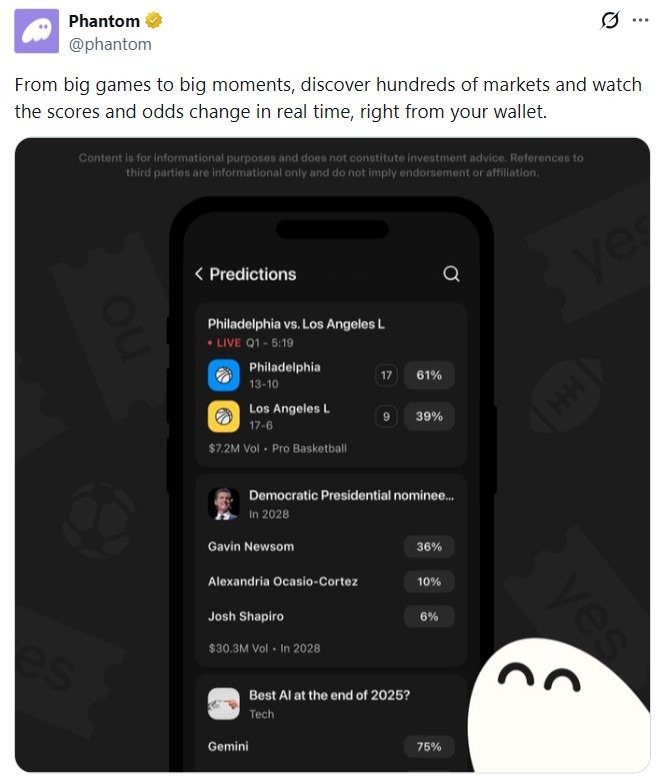
The companies said Friday that the integration would allow Phantom users to discover trending events, track live odds and place bets without leaving their wallets.

A new feature called Phantom Prediction Markets would allow users to trade tokenized positions that reference Kalshi’s event markets across politics, economics, sports and culture.

“By integrating a layer of tokenized positions referencing Kalshi’s regulated event markets with Phantom, users can trade what they care about in real time,” said Phantom CEO Brandon Millman.
Source: Phantom

Crypto exchanges eye US prediction markets

Phantom’s move comes as major crypto trading platforms race to enter the US prediction markets business.

On Thursday, Gemini Titan, an affiliate of the crypto exchange Gemini, received a designated contract market license from the US Commodity Futures Trading Commission (CFTC). Gemini said it plans to enter the prediction markets space.

The exchange said that it would allow users to access event contract trading on its web platform. Following its announcement, Gemini shares went up by nearly 14% in after-hours trading.

On Nov. 19, tech researcher Jane Manchun Wong, known for discovering in-development features on Big Tech websites, claimed that crypto exchange Coinbase is working on a prediction market. Wong shared screenshots apparently showing the unreleased platform.

Citing anonymous sources, Bloomberg reported that Coinbase plans to announce the launch of its prediction markets and tokenized equities.

A Coinbase spokesperson previously told Cointelegraph that they company will hold a livestream on Wednesday to showcase new products. However, the spokesperson did not mention prediction markets or tokenized stocks.

Related: Polymarket trading figures are being double-counted: Paradigm

Prediction markets face regulatory pushback

While prediction markets have gained popularity in the US, the state of Connecticut has recently taken a stance against certain platforms.

On Dec. 4, the Connecticut Department of Consumer Protection (DCP) sent cease and desist orders to Robinhood, Kalshi and Crypto.com, alleging that they were conducting unlicensed online gambling. However, Kalshi immediately took action a day later.

The prediction market platform sued the DCP, arguing that its event contracts are lawful under federal law.

Connecticut federal court judge Vernon Oliver stated in an order that the DCP must refrain from taking enforcement action against Kalshi. This temporarily stops the DCP’s cease and desist order against Kalshi.

Magazine: Koreans ‘pump’ alts after Upbit hack, China BTC mining surge: Asia Express

İlgili Okumalar

From Gatekeeper to Gravedigger: JPMorgan Bets on Physical Precious Metals, Shorts Dollar Credit

JPMorgan Chase, a long-standing guardian of the U.S. dollar-centric financial system, is reportedly shifting its core precious metals trading team to Singapore—a move interpreted as a strategic pivot away from Western dollar hegemony. The bank has reclassified approximately 169 million ounces of silver in COMEX vaults from “deliverable” to “non-deliverable,” effectively locking down nearly 10% of global annual supply. This signals a broader bet on physical metal accumulation and a loss of confidence in paper-based derivatives. The London and New York systems, built on leveraged paper contracts (with claims far exceeding physical metal), are showing strain. Central banks are accelerating gold repatriation, while industrial demand—especially for silver in green technology—is draining physical inventories. Extreme backwardation in silver and extended delivery wait times at the Bank of England suggest a structural rupture between paper markets and physical reality. Meanwhile, Shanghai has emerged as the world’s largest physical gold exchange, emphasizing full physical settlement and rejecting the Western paper-gold model. China’s industrial demand and central bank purchasing are pulling vast metal volumes eastward, reshaping global liquidity and pricing power. Singapore is positioning itself as a neutral hub with tax-free private vaults, attracting Western institutions like JPMorgan seeking a safe, politically acceptable base near Asian demand centers. Yet it remains caught between dollar liquidity and yuan-driven physical trade anchored in Shanghai. JPMorgan’s maneuver reflects a deeper shift: the end of financial alchemy based on unlimited paper leverage and the return to a tangible asset system where physical metal defines value and trust.

比推Şimdi

From Gatekeeper to Gravedigger: JPMorgan Bets on Physical Precious Metals, Shorts Dollar Credit

比推Şimdi

Trump in Web3 Games: Temporary Hype or Trend?

The article "Trump in Web3 Games: Temporary Hype or Trend?" discusses the growing integration of political brands, particularly Donald Trump’s, into the crypto industry—especially within Web3 gaming. It highlights the recent launch of the 3D game *Trump Billionaires Club*, which features an in-game economy tied to the $TRUMP memecoin and user engagement mechanics. The piece argues that while political and media-driven narratives can generate initial user interest, they often fail to retain players without clear, sustainable incentives. Many gaming tokenomics rely on short-term emotional appeal rather than long-term engagement. In response, projects like PEPENODE are emerging with simplified, routine-based reward systems—such as virtual "mining" nodes—that require no technical knowledge or hardware. PEPENODE, promoted as the "first memecoin mine-to-earn" platform, allows users to buy and upgrade virtual mining nodes to earn rewards, including memecoins like PEPE and Fartcoin. Early data shows significant pre-sale interest, with $2.3 million raised and a token price of $0.001192. The project aims to combine meme-driven engagement with predictable, recurring action—a trend gaining traction as Web3 games seek broader, more consistent user bases beyond one-time hype. The article concludes that while politically themed games attract attention, their long-term success depends on transitioning from viral momentum to habitual use through clear mechanics and recurring value.

bitcoinist24 dk önce

Trump in Web3 Games: Temporary Hype or Trend?

bitcoinist24 dk önce

İşlemler

Spot
Futures
活动图片